
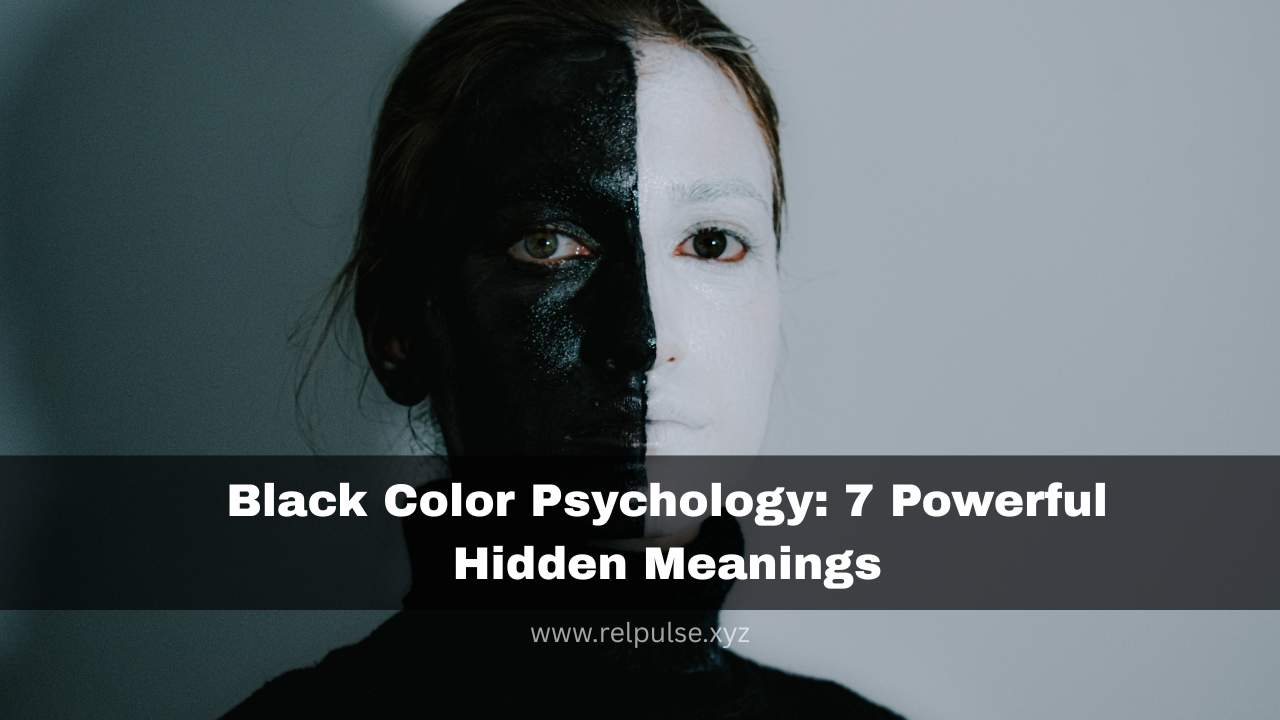
Black.
It’s in your closet, in your phone, on your car, on your favorite jacket. It shows up in weddings, funerals, business meetings, and late-night adventures. It’s the most universal “color,” yet also the most misunderstood.
Open your wardrobe and you’ll likely find it: the “little black dress,” the all-black gym outfit, the sleek black suit, or the hoodie you wear when you want to feel invisible. The reason you reach for it—and the way people react to it—is deeply connected to black color psychology.
Why do we wear black to funerals but also to luxury galas?
Why do rebellious teens prefer it while CEOs and judges use it to command respect?
Why does it make us look slimmer, stronger, more serious or more intimidating?
The answer lies in the complex, layered world of black color psychology. Black represents authority but also grief. Mystery but also clarity. Protection but also isolation. It is a color of contradictions, and understanding it gives you a psychological map into human behavior, identity, and emotion.
Today, we uncover the 7 powerful hidden meanings behind black color psychology and what this shade secretly communicates every time you wear it, see it, or decorate with it.
1. The Ultimate Symbol of Power and Authority
In the world of black color psychology, no meaning is stronger than power. Black doesn’t whisper. It doesn’t negotiate. It dominates silently.
Commanding Respect
Think of the people who wear black in society:
- Judges
- Police officers
- Formal business executives
- Presidents in black suits
- VIPs stepping out of black limousines
There’s a reason: black absorbs all light. It reflects nothing. This signals emotional self-containment and control. When you wear a black suit to a meeting, you are not there to play. You’re there to lead. You’re there to be taken seriously.
Luxury brands, black credit cards, premium cars these industries use black color psychology to signal status and exclusivity. Black says: I don’t need to speak to be respected.
2. Emotional Protection & Psychological Armor
Have you ever thrown on an all-black outfit when you felt insecure, tired, overwhelmed, or emotionally exposed? That’s not random.
One of the most comforting aspects of black color psychology is its ability to act as emotional armor.
The Shield Against the World
Black hides things:
- Body imperfections
- Emotional vulnerability
- Insecurity
- Stress
- Social anxiety
Teens often go through their “all-black” phase not because they are necessarily depressed, but because black feels safe. It creates a protective barrier between them and the world.
When you choose black, your subconscious is saying:
“I want to protect my energy. I want fewer eyes on me. I want space.”
Black gives you permission to exist quietly and safely.
3. The Symbol of Sophistication, Elegance & Luxury
If power is one side of black, elegance is the other. In fashion, black is timeless. It is the base of high fashion and luxury branding.
The Canvas of Excellence
Black is elegant because it:
- Is simple yet stunning
- Makes other colors pop
- Feels intentional, not loud
- Suggests confidence
- Implies good taste
This is why:
- Black tie events exist
- Chanel’s signature look is black
- Minimalist designers rely on black
- High-end packaging often uses matte black
Marketers rely heavily on black color psychology to make products look more expensive, rare, and exclusive.
A sleek black box makes your brain think: premium.
4. The Color of Mystery, Secrets & the Unknown
Black is the color of night, shadows, deep oceans, closed doors, and hidden truths. Within black color psychology, it represents mystery and secrecy.
The Seduction of the Unknown
We are naturally attracted to what we cannot fully see or understand. That’s why:
- Black outfits look mysterious
- Secret missions are called “black ops”
- Hidden files are “blacklisted”
- Difficult information is kept in a “black box”
People who wear black are often perceived as intriguing or unreadable. They reveal less and that makes others lean in more.
But this mystery can be both alluring and intimidating. Black invites curiosity while maintaining emotional distance.
5. Grief, Mourning & Emotional Finality
Across most Western cultures, black is the color of death, endings, and mourning. This is one of the strongest historical connections in black color psychology.
The Absence of Light
Black symbolizes:
- The end of a cycle
- Loss and grief
- Silence
- Emotional depth
- Respect for the dead
Wearing black to a funeral communicates unity in sorrow. It signals to others:
“I am hurting. Treat me gently.”
While not universal (in some cultures white is the mourning color), the psychological association with darkness, endings, and stillness makes black a natural symbol of sadness and finality.

6. Rebellion, Non-Conformity & the Outsider Identity
Black isn’t just powerful or elegant it’s also rebellious.
Throughout history, artists, musicians, and rebels have chosen black as their uniform.
Rejecting the Rules
The Beatniks wore black.
Punks wore black.
Goths wear black.
Rockstars live in black.
Why?
Because black color psychology also represents:
- Defiance
- Independence
- Creative freedom
- Breaking societal norms
Wearing black can be a quiet protest. A refusal to fit in. A statement:
“I am not like everyone else, and I’m not trying to be.”
It’s the color of the outsider and the visionary.
7. Emptiness, Depression & the Dark Side
While black can protect and empower, too much of it can overwhelm your emotional world.
This is the negative side of black color psychology.
The Weight of the Shadows
Black is heavily associated with:
- Isolation
- Silence
- Emotional numbness
- Darkness
- Depression
- Cynicism
People in deep sadness often describe their world as “dark” or “black.”
Homes decorated entirely in black can feel heavy or draining unless balanced with light.
Words like:
- “Black mood”
- “Blackmail”
- “Blacklisted”
…all carry negative, shadowy meaning.
If someone is drawn only to black for long periods, it can be a sign they are emotionally withdrawing.
How to Use Black Psychology to Your Advantage
Now that you understand black color psychology, here’s how to use it intentionally:
For Power:
Wear a tailored black blazer or suit when negotiating, presenting, or leading.
For Protection:
Use black clothing on days you feel overwhelmed, anxious, or overexposed.
For Elegance:
Use black accessories to elevate a simple outfit instantly.
To Avoid Negativity:
If you’re wearing too much black and feeling low, balance it with:
- White
- Gold
- Pastels
- Bright accents
Black needs contrast to avoid emotional heaviness.
Conclusion
The world of black color psychology is rich, deep, and full of contradictions. Black is not simply “dark” or “sad.” It is a powerful emotional language.
Black can:
- Empower you
- Protect you
- Elevate you
- Hide you
- Silence you
- Inspire you
- Intimidate you
It is the color of strength and secrets, endings and beginnings, authority and rebellion.
Understanding black color psychology helps you read people, environments, and even your own emotional patterns more clearly. Whether it’s a judge’s robe, a mourner’s veil, a luxury brand logo, or a rebel’s leather jacket black always has something to say.
And now, you know exactly what it means.
Ready to take the next step in your personal growth? Explore expert services from therapy to life coaching — available on Fiverr.
If you want to read more articles similar to Black Color Psychology: 7 Powerful Hidden Meanings
we recommend that you enter our Love life category.
FAQs
1. Does wearing black mean I’m depressed?
Not always. Many people wear black because it’s stylish, slimming, or convenient. In black color psychology, context matters. If you wear black to hide emotionally, that’s different from wearing it to feel powerful.
2. Why do teenagers love wearing black?
Teens use black as protection and rebellion. They feel overwhelmed by emotions and identity shifts, and black provides emotional safety. According to black color psychology, it also helps them signal independence.
3. Is black considered a real color?
Physically, black is the absence of light. But in art, design, and black color psychology, it is absolutely considered a powerful color because of its emotional effects.
4. Can painting a room black affect mood?
Yes. A fully black room can feel heavy or claustrophobic. Using black as an accent creates sophistication without emotional weight.